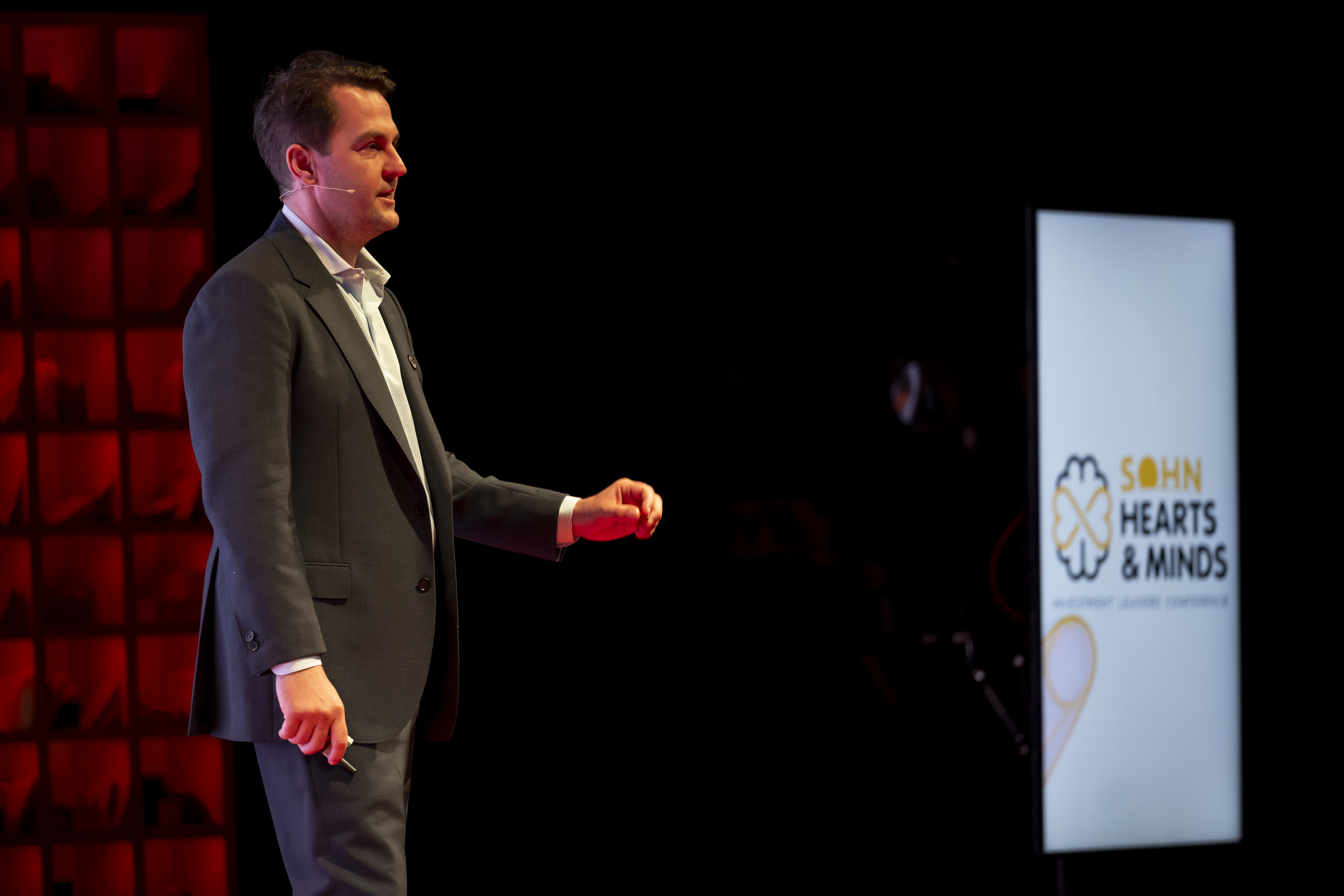
According to Singapore-based global strategist with Rabobank Michael Every, countries have spent decades optimising for quarterly or annual GDP numbers without asking what growth is actually for: and that is safety, sovereignty and resilience.
The one question every Western nation needs to answer is “What is GDP for?”
According to Singapore-based global strategist with Rabobank Michael Every, countries have spent decades optimising for quarterly or annual GDP numbers without asking what growth is actually for: and that is safety, sovereignty and resilience.
But this failure to lock in a mission statement underlines the other economic stresses, whether that be housing dysfunction through to immigration debates or industrial policy. Look at most developed Western economies and the furious policy debates Australia is having are the same.
Every’s day job is to think about the very big risks looming over the market as much as their origins. His clients invest over the long term and he wants them to be well prepared.
He has spoken with The Australian just as two major economic pressure points have hit. The Albanese government has sniffed the direction of political winds, and has blamed a housing shortage for its pledge to cut immigration in the coming years. The second pressure point is Treasury’s release of the intergenerational review, which shows Australia will be stuck in a low-growth, ageing economic cycle; although the assumptions are underpinned by some bullish predictions about productivity supported by AI.
“What is GDP is for?” Every asks. “What are we trying to be? What’s the goal? To what end?”
Every says that as you watch countries – from Australia, New Zealand, the US, Canada, to Europe or the UK – start asking themselves that question rather than just focusing on the quarter-by-quarter number of GDP “you get radically transformative outcomes in geopolitics, in geo-economics, in markets, and dare I say, in the housing market”.
The focus is on hitting a GDP number, which in Australia’s case is the obsession about hitting top-line growth. But that masks underlying stains like GDP per capita. (It has stalled since Covid-19). Then there’s the GDP per median income in real terms (it’s been going backwards).
“Great – your economy grew 2.5 per cent. What did it do for the average person? It’s negative,” Every says.
“When global norms are threatened, global security is threatened supply chains are insecure; In what world does it make sense to then have so much mental and physical energy tied up with ‘we won this quarter’?”.
Every is among speakers at the 11th Sohn Hearts & Minds Investment Leaders Conference on November 6, to be held in Queenstown, New Zealand – the first time the conference has been staged outside Australia.
He frames the past five decades – which has been characterised by globalisation, free trade and deregulation – as the exception in human economic history, not the normality.
Here, it is snapping back to the baseline: bare-knuckle trade, resource leverage and the rise of empires. It’s no coincidence Donald Trump and “America first” has emerged from this.
“I tell my clients for 99.9 per cent of human history, that was reality. You didn’t sit there thinking: ‘I have complete freedom and independence to do whatever I want. No, you don’t’,” Every says.
“Most of empire, most of human history was empires and conquering and fighting to get any little sliver of sovereignty or autonomy. We’ve had a 45-year window in which post-World War II, post-Cold War, under an American security umbrella, everyone – big or small – dreamed they had it and planned accordingly. We’re going back to the way things were. At which point, everything else needs to change.”
It’s no surprise, but Every says commodities and supply chains are the new geopolitical battleground.
The control of energy, critical minerals, food and industrial inputs will determine who has real leverage. He frames Trump’s strategy (Middle East, Venezuela, Panama Canal, Canadian resources) as an attempt to lock down the world’s two oil “centres of gravity” (Middle East and the Americas) to squeeze commodity dependent rivals like China.
Even Australia had its own recent taste of trade nationalism. He points out Prime Minister Anthony Albanese’s whistlestop tour through Asia earlier this year that took in Singapore, Brunei and South Korea, used LNG exports and critical minerals as bargaining chips to secure the flow of petrol.
That situation, which went around existing trade deals was “bare knuckle”.
“It was a case of ‘we’ve got something you need. You’ve got something we need. Do we have an understanding?’ A lot more of that kind of thing will have to emerge,” Every says.
His broader point is that countries which let market logic dismantle their strategic leverage – such as Australia not seeing the strategic issues in allowing its fuel refineries to close – lose their bargaining power exactly when they need it most.
In a 2019 paper titled “The Age of Rage” he predicted the far right would become a major force and argued the pursuit of centralism creates far more losers on the fringe – which pushes more people to the extreme left and right.
Every says that markets are still reading events through a “line-on-a-screen” lens (interest rates, quarterly GDP) rather than the strategic frame he uses, and that this gap is where volatility and surprises (Brexit, Trump, bond yields) keep reoccurring.
Even Canada’s recent efforts to potentially join or become more alignment with the EU is essentially symbolic politics, not a realistic option. This still creates lessons for Australia. If Canada pursued it seriously this would ultimately be dangerous, if at the very least as a trading threat to the US.
He nominates energy as the most serious medium-term risk for Australia. There’s a possibility the conflicts in the Middle East and Russia-Ukraine could merge. The problem is our energy system was built for a world of free trade and which assumed it would always be there.
“For Australia, the biggest risk is that you’re living with that pressure, but it’s starting to bleed down here because of lack of resilience in the economy,” Every says.
Despite the grim outlook, Every insists he’s ultimately an optimist over the medium to long term. He believes a period of stability can emerge, much like the post-World War II era, but only after a difficult transition, and only if societies collectively answer the question of what GDP is for. This way the gains will be spread more broadly.
The 2026 Sohn Hearts & Minds Investment Leaders Conference will be held in New Zealand on November 6.
This article was originally posted by The Australian here. Licensed by Copyright Agency. You must not copy this work without permission.


Sohn Hearts & Minds today announced that Robert F. Smith, Founder, Chairman and CEO of Vista Equity Partners, will headline the near-sold-out 2026 Investment Leaders Conference in Queenstown, New Zealand, on 6 November.
It seems hard to believe, but just a little over two years ago an investment in frontier artificial-intelligence play Anthropic was considered a contrarian bet. Today the start-up behind the Claude model is on the cusp of a $US2 trillion ($2.7 trillion) stockmarket listing.

In an episode of The Astute Investor, hosted by long-standing Sohn Hearts & Minds Conference supporter LGT Wealth Management, Martin Randall speaks with Isaac Kim and Michael Romano of Lightspeed Venture Partners about the opportunities, risks and investment implications of AI.
.svg)
.png)