It seems hard to believe, but just a little over two years ago an investment in frontier artificial-intelligence play Anthropic was considered a contrarian bet. Today the start-up behind the Claude model is on the cusp of a $US2 trillion ($2.7 trillion) stockmarket listing.
It seems hard to believe, but just a little over two years ago an investment in frontier artificial-intelligence play Anthropic was considered a contrarian bet. Today the start-up behind the Claude model is on the cusp of a $US2 trillion ($2.7 trillion) stockmarket listing.
Lightspeed Venture Partners, among Silicon Valley’s most influential venture funds, made an early call that the powerful models Anthropic was building wouldn’t stand still and that they’d only become more valuable over time.
This went against the prevailing view that the likes of Anthropic or OpenAI were just one slice of the AI infrastructure chain, with the real value likely to sit in the cloud applications sitting on top of the models.
Lightspeed instead poured billions into financing for Anthropic across multiple funding rounds, upping the firm’s exposure each time.
Last September the fund co-led the bumper $US13bn Series F round. Today it is one of the biggest institutional investors in Anthropic.
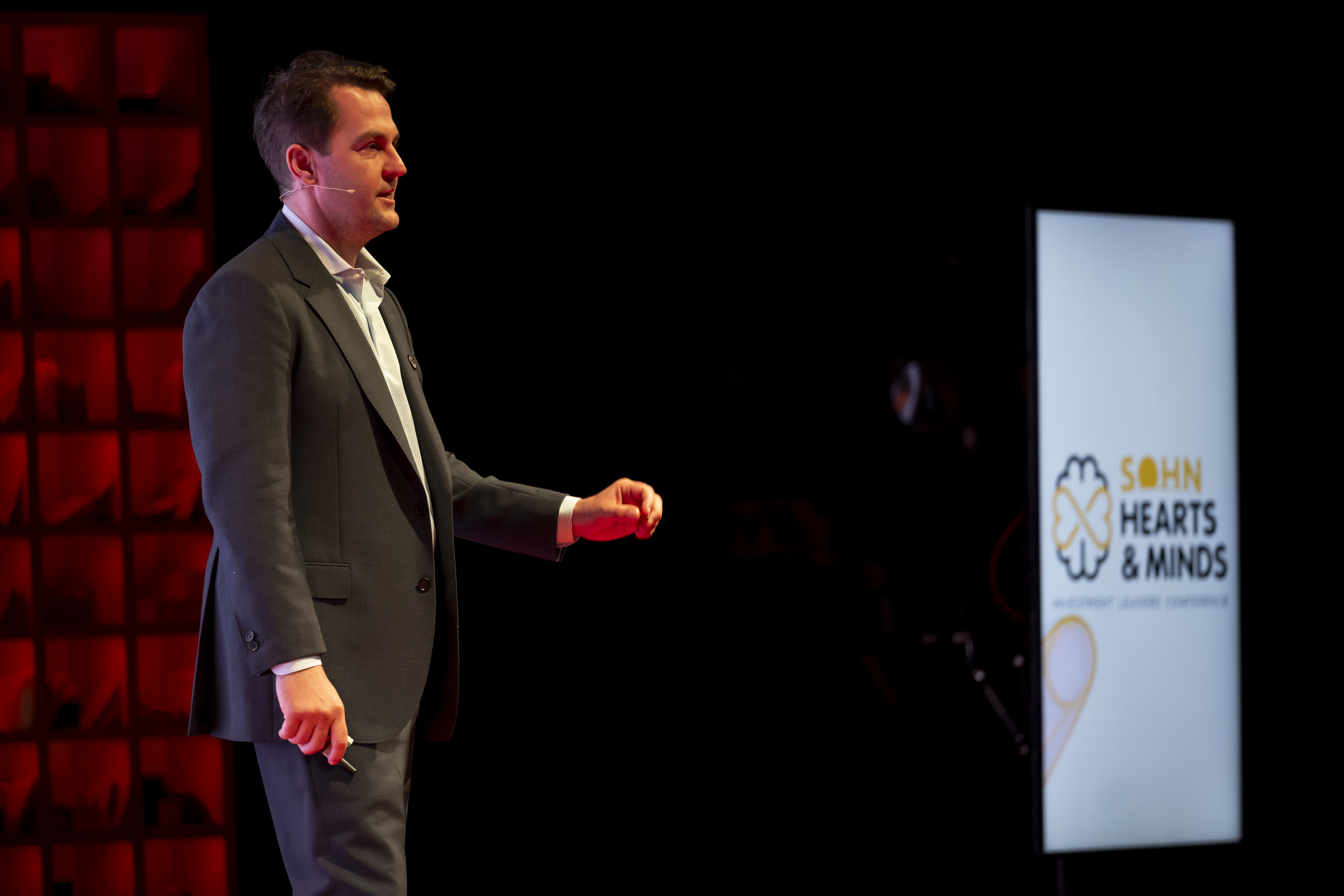
“We made a contrarian bet that this was different,” says Lightspeed partner Issac Kim in an interview with The Australian. “This was not just infrastructure. These were the research houses building the intelligence that would drive the AI wave going forward”.
That means Anthropic’s investors are in line for a likely windfall coming out of what is expected to be the world’s most valuable IPO – edging out Elon Musk’s SpaceX. Anthropic has already filed confidential IPO paperwork with the US Securities and Exchange Commission, and The Wall Street Journal has reported a listing raising as much as $US100bn could take place as early as October, depending on market conditions.
Kim can’t talk about what is next for Anthropic, including around the timing of any IPO. In fact, he won’t even be drawn on whether the float is actually on.
But if the October reports prove correct, Kim will be well placed to reveal all when he appears as a key speaker at the 11th Sohn Hearts & Minds Investment Leaders Conference on November 6, to be held in Queenstown, New Zealand – the first time the conference has been staged outside Australia. Adding to the tech theme, headlining the conference is Robert Smith, the billionaire founder of US-based Vista Equity Partners, one of the world’s biggest software investors.
Sohn Hearts & Minds raises funds for medical research and including this year’s conference, total donations are expected to pass $100m. (The Australian is a media partner of the Sohn Hearts & Mind conference).
Kim recalls Lightspeed’s second investment round into Anthropic, when it led the $US3.5bn Series E financing in March last year. It happened the very same week the Chinese open-source model DeepSeek burst onto the scene, threatening to up-end premium, closed models like Anthropic’s and OpenAI’s. Shockwaves from DeepSeek ripped through Silicon Valley as much as through markets, with fears the AI revolution was heading toward commoditisation before it had even properly started.
But Lightspeed held its nerve. “We had high conviction because we’d done our work,” he says.
Even today, open-source models that compete purely on price have made only modest inroads with business customers. Kim believes what actually matters for enterprise buyers is cost per successful outcome, not cost per token. If an open-weight model needs four attempts to get a task right, while a frontier model delivers it on the first try, the frontier model is actually cheaper in practice – despite a higher headline price per token.
Anthropic focused its early development almost entirely on business customers, on the basis that the right AI tools represent a genuine competitive edge.
“If you’re Coke versus Pepsi, and it’s a mission-critical technology use case, are you going to use the second-tier model, or are you going to use the frontier model for that use case?”
Still, he’s careful not to dismiss open-weight models outright. Lightspeed has active bets in the space too – Mistral in Europe, and Reflection as a US-aligned open-weight play.
“There are use cases for both,” he says.
The AI revolution is changing the entire nature of Silicon Valley, after a region that had grown comfortable dominated for years by half a dozen big tech names that were heavily consumer-focused and starting to push middle age. Kim says AI has turned all that on its head, including the investment component, spurring a wave of companies built around science rather than social media.
“I’ve been in the Valley for 20 years,” Kim says. “It’s back.”
He says AI start-ups have reintroduced dynamism across Silicon Valley.
“You see people voting with their feet” – a reference to top talent leaving established majors to join, or found, new ventures. He points out that the region’s centre of gravity is returning, with more than 500 AI start-ups now based across Silicon Valley, by far the largest of any US city.
Perhaps the most significant shift, Kim says, is that businesses are now hitting $US100m in revenue within months rather than a decade, and reaching billion-dollar – even trillion-dollar – valuations within a few years. Previously that kind of scale took generations to build. It has completely reset what founders, employees and investors believe is possible, and it’s why more capital is being funnelled into early-stage investing, private credit, and a new wave of specialist digital infrastructure funds.
We’re speaking as the issue of AI safety has flared up again – a former Anthropic engineer warned this week of the potential for AI to wipe out humanity. Kim won’t be drawn on that specific claim, but says that as an investor he’s constantly thinking about the issue, and is comfortable Anthropic has the right guardrails in place.
Anthropic itself was founded only in 2021, by a string of engineers who left OpenAI wanting to build AI with a stronger eye on safety.
“One of the reasons why we invested in Anthropic in the first place is the focus on safety – and enterprise scalability and security. So we do think about it,” he says.
Safety is one of several emerging themes beyond the frontier models themselves that Kim is chasing for new investments. Lightspeed recently participated in a funding round for a start-up founded by Palo Alto Networks billionaire founder Nir Zuk, designed specifically to tackle AI-driven cyber threats. “There needs to be a new way of thinking about cyber defence,” Kim says.
Other frontier areas ripe for early-stage investment include technologies aimed at more efficient energy use, along with defence tech and robotics. More recently, Kim has been drawn to a different kind of theme entirely – dusting off businesses that have run the same way for 30, 40, even 50 years. “Can you reinvent them with AI?” he asks.
From his view, demand for AI services is real, which means the biggest constraint isn’t demand at all – it’s supply: access to computing power, and the upstream inputs of raw materials and energy. That, he says, is the driver behind the eye-watering global spend on digital infrastructure.
Any listing of Anthropic would come hot on the heels of June’s $US1.75 trillion SpaceX IPO. OpenAI, meanwhile, is slated to push ahead with its own multitrillion-dollar listing early next year. SpaceX is now trading back above its $US135-a-share offer price, but its listing represented an early test of whether public markets can digest mega-IPOs of this scale.
“I think the answer to that is yes,” Kim says.
This article was originally posted by The Australian here.
Licensed by Copyright Agency. You must not copy this work without permission.
.png)

According to Singapore-based global strategist with Rabobank Michael Every, countries have spent decades optimising for quarterly or annual GDP numbers without asking what growth is actually for: and that is safety, sovereignty and resilience.

Sohn Hearts & Minds today announced that Robert F. Smith, Founder, Chairman and CEO of Vista Equity Partners, will headline the near-sold-out 2026 Investment Leaders Conference in Queenstown, New Zealand, on 6 November.

In an episode of The Astute Investor, hosted by long-standing Sohn Hearts & Minds Conference supporter LGT Wealth Management, Martin Randall speaks with Isaac Kim and Michael Romano of Lightspeed Venture Partners about the opportunities, risks and investment implications of AI.
.svg)
.png)
.png)
.png)